
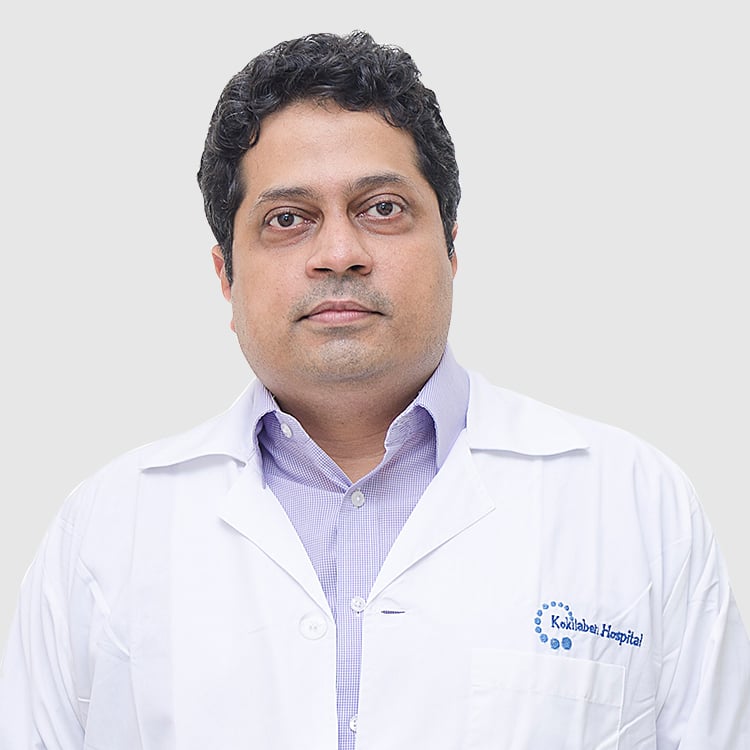
MBBS, MS, DNB
Breast Oncology & G I Oncology
We established the Kokilaben Hospital Breast Care Unit in 2009 - it was based on the guidelines set by the European Society of Mastology (EUSOMA) - it included all fields from screening to diagnosis to multimodal care and even palliative care and pain clinic - over the last 17 years we have performed over 9500 breast cancer related procedures varying from simple surgeries like Modified Radical Mastectomies and Breast conservation to very advanced Oncoplastic procedures that have now become standard of care .
We also set up a Port clinic to enable patients needing systemic chemotherapy to have access to central venous access devices like chemo ports or PICCs.
Very early after starting the unit we adopted Oncoplastic surgery techniques as standard of care for our patients starting with basic level I Oncoplastic surgical procedures such as Benelli technique, Hemi round block technique, parallelogram Oncoplasties, batwing technique and E3 Grisotti flaps for central quadrant lesions to allow excellent cosmetic outcomes for our patients without affecting oncological safety.
We then moved on to reduction mastopexy techniques that permitted breast volume reduction and mastopexy as cosmetic additives to oncological resection with good effect - the last 5 years the unit has trained and adopted advanced Oncoplastic surgery which includes performance of extensive breast resections including mastectomies and immaculate reconstruction using chest wall perforator flaps (a new concept for the last few years) .
We regularly perform Lateral Intercostal artery perforator (LICAP), anterior Intercostal artery perforator flaps (AICAP), Medial Intercostal artery perforator flaps (MICAP) and lateral thoracic artery perforator (LTAP) flaps . We have also devised our own modified technique of LICAP to minimise scars and improve cosmetic outcomes - these flaps have enabled breast surgeons to carry out extensive (>30%) breast volume resections with ease and superlative cosmetic outcomes.
For patients needing or choosing mastectomies over conservative procedures we established a whole breast reconstruction program very early on. Since inception of the unit we have been performing performing Nipple areola sparing mastectomies and subcutaneous mastectomies with assistance of a well trained reconstructive surgery department skilled in implants, pedicled flaps and free tissue transfer with excellent results - we have data with over 600 such patients . We also have the highest number of series of cases with prophylactic bilateral mastectomies and reconstruction in patients unfortunate to have hereditary breast cancer owing to pathogenic mutations in BRCA 1 and 2 genes
In 2009 we established the first sentinel node biopsy program in Mumbai with dual technique (using methylene blue dye and Tc99 radioactive isotope) for detection of the first echelon node to where the cancer may have spread - this enables surgeons to identify patients without axillary nodal spread thereby avoiding unnecessary axillary nodal dissection and preventing Lymphedema - 8 years later we moved on to dual technique using the latest Indocyanine green technique using the SpY-phi system that is known to give better identification of sentinel nodes- this technique is the present standard of care- we were again the first to adopt evidence based management of the axilla in single sentinel node positive patients adopting the results of Amaros trial to radiate the axilla and avoid Lymphedema to good effect.
In patients undergoing neoadjuvant chemotherapy we use Sentinel Biopsy dual technique in all patient with uninvolved nodes - in patients with involved nodes that turn disease free after upfront chemotherapy we have adopted the gold standard (from MD Anderson CC) technique of targeted axillary dissection using markers to identify the sentinel nodes along with dual technique . This technique raises safety of axillary sentinel node detection by reducing false negative rates below 10% - all of the above enabling limited axillary surgery and reducing Lymphedema rates - translates into excellent quality of life
In patients who need axillary lymph node dissection (unavoidable in patients with a heavy nodal disease burden) we have a standard policy of performing Slympha and micro vascular lympha technique (by our microvascular team) to identify affected lymphatics of the arm following a complete axillary lymph node dissection using reverse axillary mapping and reconnecting them back to the tributaries of the axillary vein using microvasular techniques with superfine sutures. This technique has been shown to reduce lymhpedema rates to 10-14% - again translating into better quality of life for our patients
Management of impalpable lesions -
With a thriving executive health check up programme in our institution we encounter a sizeable number of screen detected cancers seen on mammography that are yet not clinically evident.
With the advent of neoadjuvant chemo in triple negative and her2neu positive patients- as many as 65% patients will show near complete to complete response and the surgery involves removal of impalpable lesions using stereotactic mammo-localizations and hook wire techniques - we have used intraoperative ultrasound to guide us in the excision of impalpable solid lesions since inception - a technique that improves accuracy and is fail safe. Over the last many years we have data of over 1500 patients treated by this technique successfully.
Awareness programmes - as part of our commitment to society the breast unit has been a part of various conferences, forums, social gatherings etc in raising awareness about breast health helping to disperse knowledge about breast cancer screening, prevention, early detection, recent advances to help generate a consciousness among the common people about how one should be breast aware.
Visiting observership to Centre Oscar Lambret where he trained himself in oncoplastic surgery and implant reconstructions
Invited faculty for the Breast Health Global Initiative (BHGI is run by the Fred Hutchinson Research Centre, Washington) as an invited representative from India to brainstorm and formulate guidelines for breast cancer management in the developing world.
World Health Organisation panel - In 2007 he coordinated the Indian panel for development of guidelines for treatment of breast cancer in India depending upon different levels of available infrastructure at different oncology centres across the country.
Landmark publications
I arrived in Mumbai India on 2nd July 2025 in great pain have been diagnosed with Cancer of the Breast that had affected my neck bones. We were referred to Kokilaben Dhirubhai Ambani Hospital by a member of my family who had received treatment ...
Dr Mandar was quick and provided proper information about the disease.
Everything was simply perfect. In terms of treatment Dr. Mandar 's excellence and co-operation was unmatched. Feeling glad to come here fo...
I am a patient of Dr. Mandar Nadkarni since 2014.Then Dr. Sandeep Goyle, Dr. Subhash Agal and Shashank Mishra. All these doctors are really very good and very nice and excellent service to me as apatient.
Fairly good experience. Dr Mandar Nadkarni and Dr. Gowtham guided us well.
Overall good experience, big thank you to the Dr. Mandar Nadkarni and assistant Dr. Husefa and their team.And all the nurses have been very helpful.
Dr Mandar Nadkarni ji and his supporting staff are very humble and caring. Their diagnosis and treatment are perfect. They are second God to all their patients. God bless them all.
I am writing this mailer as a note of thanks and gratitude to KDMH and it's staff towards the services that they delivered in times of distress.
My mother (Renuka Jain) was diagnosed with breast cancer in 1st week of April.
| No. | Journal Code | Department | Type | Download | |
|---|---|---|---|---|---|
| 1 | 40 | Center for Cancer | International | - | |
Publication/Talk Title : Postoperative Interstitial Brachytherapy in Eyelid Cancer: Long Term Results and Assessment of Cosmesis after Interstitial Brachytherapy Scale Journal Published : Journal of Contemporary Brachytherapy |
|||||
| Conditions/Procedures | No. of Cases Treated | International Success Rate | KDAH Success Rate |
|---|---|---|---|
| Breast cancer | >7500 | - | - |
| Oncoplastic surgeries including Therapeuic mammoplasty and Whole beast reconstruction(including free flaps) |
>500 | - | - |
| SNOLL (Sentinel node and occult lesion localization) |
>4 | - | - |
| Hookwire localization for impalpable lesions | >100 | - | - |
This appointment request is for regular consultation with the Doctor at Kokilaben Hospital, Four Bungalows. For online consultation, please CLICK HERE