
Introduction
When your doctor recommends a CT scan or an MRI, it is natural to wonder what each test involves and why one has been chosen instead of the other. Both are among the most powerful diagnostic imaging tools in modern medicine, but they work differently, each revealing different aspects of the body with different levels of precision.
Understanding the difference between CT scans and MRIs can help you feel more prepared, ask the right questions, and make informed decisions about your care. At Kokilaben Dhirubhai Ambani Hospital, our advanced radiology services and expert radiologists ensure that every patient receives the most clinically appropriate imaging, accurately, safely, and promptly.
Concerned about a symptom? Speak to our specialists today.
What Is a CT Scan?
A CT (computed tomography) scan uses rotating X-ray beams and a computer to create detailed cross-sectional images of the body. In any comparison of CT scan vs MRI, CT is usually preferred when speed is crucial and when evaluating bones, lungs, or internal bleeding.
It is especially useful in emergencies such as acute intracranial haemorrhage, head injuries, and suspected stroke (to rule out bleeding before treatment).
- Chest conditions: pulmonary embolism, pneumonia, aortic aneurysm
- Abdominal emergencies: appendicitis, kidney stones, bowel obstruction
- Cancer detection, tumour staging, and CT-guided biopsy procedures
Fracture assessment and post-surgical follow-up capture detailed cross-sectional images of the body. A computer processes these images to produce high-resolution two- and three-dimensional views of bones, organs, blood vessels, and tissues, all within minutes.
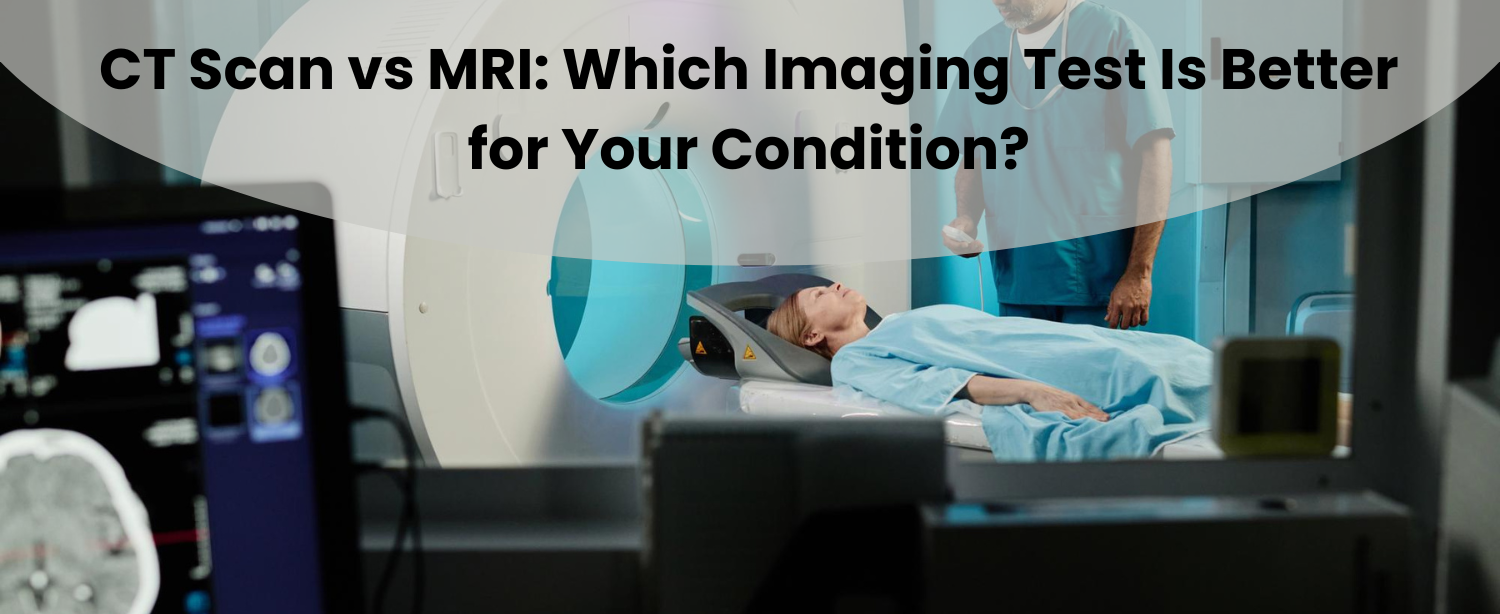
The difference between a CT scanner and an MRI machine is immediately apparent: the CT scanner has an open, ring-shaped gantry that patients pass through quickly, while the MRI has an enclosed cylindrical bore. For patients who need rapid answers, CT is often the first-line investigation.
What CT Scans Are Used For:
CT scans are typically completed in 2 to 10 minutes, making them the preferred choice at the best hospital for emergencies in Mumbai, where time-critical diagnosis can be the difference between recovery and complication.
What Is an MRI Scan?
An MRI (magnetic resonance imaging) scan uses a powerful magnetic field and radiofrequency waves, not radiation, to generate highly detailed images of soft tissues, the nervous system, joints, and organs. When comparing MRI and CT scans, MRI is usually chosen for problems involving the brain, spinal cord, ligaments, tendons, and internal organs that require fine soft-tissue detail.
Because MRI involves no ionising radiation, it is especially suitable for children, pregnant women, and patients who require repeated imaging over time.
What MRI Scans Are Used For:
- Brain and neurological conditions: tumours, multiple sclerosis, epilepsy, dementia workup, pituitary lesions
- Spine and disc pathology: disc prolapse, spinal cord compression, nerve root evaluation
- Musculoskeletal injuries: ligament and tendon tears, cartilage damage, bone marrow pathology
- Pelvic and gynaecological conditions: uterine fibroids, ovarian masses, prostate cancer staging
- Liver, pancreas, and biliary tract characterisation
Patients with claustrophobia or anxiety about enclosed spaces should inform their physician beforehand; open-bore MRI configurations and mild anxiolytic premedication can be arranged.
Book your MRI or CT scan at our accredited radiology clinic.
CT Scan vs. MRI: Key Differences
The differences between CT and MRI come down to technology, speed, anatomical strengths, and patient suitability. Here is a side-by-side comparison to help you understand which modality may be more relevant for your condition.
| Parameter | CT Scan | MRI Scan |
| Imaging Technology | Ionising X-ray radiation | Magnetic fields & radio waves |
| Scan Duration | 2–10 minutes | 20–90 minutes |
| Best For | Bones, lungs, and acute emergencies | Brain, spinal cord, soft tissues |
| Radiation Exposure | Yes (low, optimised dose) | None |
| Scanner Design | Open ring — quieter | Enclosed bore — louder |
| Contrast Agent Used | Iodinated contrast (IV/oral) | Gadolinium-based contrast (IV) |
| Cost & Availability | More accessible; lower cost | Specialist centres; higher cost |
The choice between a CT scan and an MRI is rarely about one being superior to the other; it is about which modality is most appropriate for your specific clinical situation. Your radiologist and treating physician will determine this based on your symptoms, medical history, and the diagnostic question at hand.
When Do Doctors Recommend a CT Scan?
Speed and anatomical breadth make CT the default imaging investigation in emergency and acute care settings. When every minute counts, as in a suspected stroke, internal haemorrhage, or major trauma, CT provides rapid, whole-body diagnostic clarity.
Doctors typically recommend a CT scan when:
- Emergency conditions arise: Acute head injury, suspected intracranial bleed, polytrauma, haemodynamic instability, or aortic dissection requiring immediate assessment.
- Pulmonary or vascular pathology is suspected: Pulmonary embolism, pneumonia, pleural effusion, or coronary artery disease evaluation.
- Abdominal symptoms are acute: Suspected appendicitis, renal colic, diverticulitis, or bowel obstruction, where rapid diagnosis guides urgent surgical or medical management.
- Cancer staging or monitoring is required: CT reliably delineates tumour size, lymph node involvement, and metastatic spread across the thorax, abdomen, and pelvis.
At Kokilaben Dhirubhai Ambani Hospital, widely regarded as the best hospital for emergency in Mumbai, our emergency radiology unit operates round the clock, with CT imaging available within minutes of patient presentation.
When Is an MRI Better Than a CT Scan?
When detailed visualisation of soft tissues, neurological structures, or the musculoskeletal system is the priority, MRI consistently outperforms CT. In the CT scan vs MRI comparison, MRI offers significantly better soft-tissue resolution and can detect subtle abnormalities that a CT scan may not clearly resolve.
MRI is the preferred investigation when:
- Neurological evaluation is required: Conditions such as multiple sclerosis, brain tumours, epilepsy, and cognitive decline require the superior soft tissue contrast that only MRI provides.
- Orthopaedic and soft tissue injury is suspected: Anterior cruciate ligament tears, rotator cuff pathology, meniscal injuries, and bone marrow lesions are best assessed with MRI.
- Radiation-free imaging is essential: For paediatric patients, pregnant women (particularly in the second and third trimesters), and patients requiring longitudinal follow-up, MRI eliminates cumulative radiation risk.
- Pelvic and abdominal organ characterisation is needed: Uterine, ovarian, hepatic, and prostatic conditions are more precisely characterised with MRI than CT.
These examples help clarify the CT scan and MRI differences in real clinical scenarios.
CT Scan vs. MRI for Different Conditions
The difference between CT scan and MRI becomes most clinically meaningful when applied to specific conditions and body regions. The following guide reflects standard radiological practice:
- Head and Brain: CT is first-line for acute haemorrhage and head trauma. MRI is indicated for stroke follow-up, tumour characterisation, dementia workup, and MS lesion assessment.
- Spine and Neck: MRI is preferred for disc prolapse, spinal cord pathology, and nerve compression. CT is used for acute fracture evaluation and post-operative implant assessment.
- Chest: CT is the standard modality for pulmonary and vascular pathology. Cardiac MRI is reserved for cardiomyopathy, myocardial viability assessment, and congenital anomalies.
- Abdomen and Pelvis: CT is the first-line investigation for the acute abdomen. MRI provides superior soft-tissue characterisation of liver lesions, pancreatic pathology, and pelvic disease.
- Bones and Joints: CT excels at cortical bone detail and fracture mapping. MRI is preferred for ligamentous, cartilaginous, and bone marrow pathology.
- Breast and Prostate: Multiparametric MRI is the standard for high-risk breast screening and local staging of prostate carcinoma.
Your treating physician, in consultation with our radiology team, will determine the most appropriate imaging pathway based on your unique clinical presentation.
Pros and Cons of CT Scan and MRI
CT Scan — Advantages
- Rapid acquisition (2–10 minutes) — essential in emergency and critical care settings
- Superior spatial resolution for bony structures, pulmonary parenchyma, and vascular pathology
- Widely available across most hospitals and diagnostic centres; generally lower cost
- Compatible with most metallic implants and surgical hardware
CT Scan — Considerations
- Involves ionising radiation; doses are carefully optimised using the ALARA principle, but cumulative exposure from repeated scans should be clinically justified
- Inferior soft tissue contrast compared with MRI for neurological, musculoskeletal, and pelvic structures
- Iodinated contrast agents may be contraindicated in patients with significant renal impairment or contrast allergy
MRI — Advantages
- No ionising radiation, safe for children, pregnant patients, and those requiring repeated imaging
- Exceptional soft tissue contrast, enabling precise characterisation of the brain, spinal cord, joints, and organs
- Multiplanar image acquisition without repositioning the patient, yielding comprehensive anatomical information
MRI — Considerations
- Longer scan time (20–90 minutes) may be challenging for acutely unwell or claustrophobic patients
- Significant acoustic noise during imaging; ear protection is provided routinely
- Higher cost and reduced availability compared with CT in some settings
- Contraindicated in patients with certain ferromagnetic implants, cardiac pacemakers, cochlear implants, or intraocular metallic foreign bodies, rigorous pre-scan safety screening is mandatory
Is a CT Scan Safer Than an MRI?
Neither modality is categorically safer than the other; safety depends on the individual patient’s clinical context, implant history, and the specific diagnostic indication.
CT exposes patients to a small but measurable dose of ionising radiation. For a single examination in an adult, this is well within clinically acceptable limits and governed by the ALARA (as low as reasonably achievable) principle. However, repeated CT examinations, particularly in younger patients, warrant careful clinical justification.
MRI carries no radiation risk, but requires thorough pre-scan safety screening. Patients with ferromagnetic implants, implantable cardiac devices (pacemakers or defibrillators), cochlear implants, or retained metallic foreign bodies must be assessed by a specialist before any MRI examination. All patients are advised to disclose their complete medical, surgical, and implant history to our radiology team before attending either scan.
At Kokilaben Dhirubhai Ambani Hospital, our radiology clinic follows internationally accredited protocols for imaging safety, contrast administration, and radiation dose optimisation, ensuring every patient receives the highest standard of care.
How Doctors Decide Between CT Scan and MRI
The decision between a CT scan and an MRI is rarely straightforward; it reflects a careful integration of clinical, logistical, and patient-specific factors. At Kokilaben Dhirubhai Ambani Hospital, our multidisciplinary team of clinicians and radiologists collaborates to ensure that the most appropriate diagnostic investigation is selected for every patient.
The key factors that guide this decision include:
- Clinical urgency: CT is chosen for haemodynamically unstable or acutely unwell patients where rapid diagnosis is critical. MRI is appropriate for sub-acute and elective investigations where diagnostic precision is the priority.
- Anatomical target and diagnostic question: The body region under investigation and the specific pathological process are the primary determinants of modality selection.
- Radiation sensitivity: Patient age, pregnancy status, and the likelihood of repeated imaging are weighed against the diagnostic benefit of radiation-based investigation.
- Implant and contraindication status: The presence of metallic implants, cardiac devices, or known contrast allergies may preclude or modify the imaging choice.
- Prior investigation results: Review of existing imaging and laboratory findings, including those from our accredited
Prior results from our accredited pathology lab in Mumbai and previous radiology reports are reviewed alongside clinical findings to guide the imaging pathway and avoid unnecessary duplication of investigations.
Conclusion
The CT scan vs. MRI decision is not about which technology is better in isolation, it is about which investigation is right for your condition, your body, and your clinical needs. CT scanning delivers speed, precision, and breadth in emergencies and bony pathology. MRI offers unmatched soft tissue resolution and radiation-free imaging for neurological, musculoskeletal, and complex organ-based conditions.
At Kokilaben Dhirubhai Ambani Hospital, you benefit from both, delivered by experienced radiologists, supported by advanced imaging equipment, and integrated within a comprehensive multi-specialty care environment. Whether you require an urgent scan or a planned diagnostic investigation, our team is committed to accuracy, safety, and clinical excellence at every step.
Schedule your imaging consultation at Kokilaben Dhirubhai Ambani Hospital today.
Frequently Asked Questions
1. Can a CT scan and an MRI be done on the same day?
Yes, physicians often order both for complementary diagnostics. Sequencing depends on clinical urgency and facility scheduling. Kokilaben coordinates efficiently.
2. Do CT scans or MRI scans require any special preparation?
Contrast studies need 4-6 hours of fasting. MRI requires removing all metal objects and screening for implants. Specific instructions provided at booking.
3. Are CT scans or MRI scans painful?
Neither is painful; you lie still during scanning. MRI produces noise (ear protection provided); anxiolytics are available for claustrophobia.
4. Which scan is faster?
CT completes in 2-10 minutes, ideal for emergencies. MRI takes 20-90 minutes, depending on protocol.
5. Why are MRI scans usually more expensive than CT scans?
MRI requires costly superconducting magnets and specialised facilities. Longer scan times reduce throughput. Kokilaben offers transparent pricing with insurance support.