
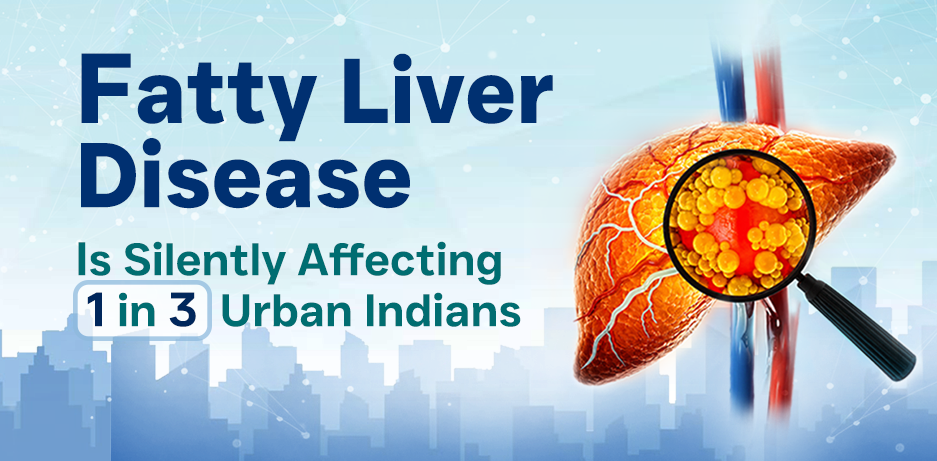
Most people who are diagnosed with fatty liver disease did not see it coming. There were no warning signs, no discomfort, and no reason to suspect that anything was wrong. A routine ultrasound or an incidental blood test result is often what brings it to light, by which point the condition may have been progressing quietly for years.
The liver is the body’s largest internal organ and one of its most metabolically active. It filters toxins, regulates blood sugar, processes fats and proteins, and performs hundreds of functions every single day. When excess fat begins to accumulate within liver cells, those functions are gradually and silently compromised, often without a single symptom to signal the change
Fatty liver disease has emerged as one of the most prevalent and underdiagnosed conditions in urban India. Its rise is closely tied to shifting dietary patterns, increasing rates of metabolic disorders, and lifestyle changes that have taken hold across Indian cities over the past two decades. What makes it particularly concerning is that by the time symptoms appear, the disease has frequently advanced well beyond its earliest, most treatable stages.
What Is Fatty Liver Disease?
Fatty liver disease, clinically referred to as steatotic liver disease (SLD), occurs when excess fat builds up in liver cells beyond the normal threshold. A healthy liver contains a small amount of fat. When that fat exceeds roughly 5% of the liver’s weight, the condition is classified as fatty liver.
The liver is responsible for filtering toxins, metabolising nutrients, regulating blood sugar, producing proteins, and performing hundreds of other daily functions. When it becomes overloaded with fat, its ability to carry out these functions is progressively compromised.
The Two Main Types
Alcoholic Fatty Liver Disease (AFLD): This occurs when heavy or prolonged alcohol consumption prevents the liver from breaking down fat effectively. Each time the liver processes alcohol, liver cells are strained. Over time, fat accumulates faster than the liver can clear it. Alcoholic fatty liver disease is well known — but it accounts for a shrinking proportion of cases in India relative to the type below.
Non-Alcoholic Fatty Liver Disease (NAFLD) — Now Called MASLD: This is the form that is driving the current epidemic. Non-alcoholic fatty liver disease (now medically termed Metabolic dysfunction-Associated Steatotic Liver Disease, or MASLD) develops in people who drink little to no alcohol. The fat accumulation is instead linked to metabolic risk factors — obesity, type 2 diabetes, high blood pressure, and abnormal cholesterol or triglyceride levels.
You Don’t Need to Drink Alcohol to Get It
This is the single most important thing most people do not know about fatty liver disease.
The widespread assumption that fatty liver is a drinker’s disease has allowed an enormous number of nondrinkers to go undiagnosed for years. In reality, the non alcoholic form is now far more common than the alcohol-related type, particularly in India, where lifestyle-driven metabolic conditions are rising sharply in urban populations.
If you are overweight, have high triglycerides, are insulin resistant or diabetic, eat a high sugar or high refined carbohydrate diet, or lead a predominantly sedentary lifestyle, you are at risk for fatty liver disease — regardless of whether you have ever touched alcohol.
How Common Is It in India — And Why Urban Indians Are Most at Risk
Fatty liver disease has reached epidemic proportions in urban India. Gastroenterologists and hepatologists across the country are reporting it as one of the most frequently encountered conditions in outpatient settings, and a significant portion of those diagnosed had no prior suspicion of liver disease.
Urban Indians face a convergence of risk factors that make them uniquely susceptible:
- Dietary shift toward ultra-processed foods — rising consumption of refined carbohydrates, packaged snacks, sweetened beverages, and fast food directly elevates blood sugar and triglyceride levels
- Physical inactivity — office based work, long commutes, and screen-heavy leisure hours have dramatically reduced average daily activity levels
- Metabolic syndrome — the combination of abdominal obesity, high blood sugar, elevated blood pressure, and abnormal lipids is increasingly common among Indians in their 30s and 40s
- Genetic predisposition — South Asians tend to develop visceral (abdominal) fat at lower BMI thresholds than Western populations, meaning a person with a “normal” weight by standard metrics may still carry dangerous amounts of metabolically active fat around their organs
- Stress and sleep disruption — chronic stress and insufficient sleep are now recognised as independent contributors to insulin resistance and liver fat accumulation
The Grades of Fatty Liver — What Grade 1, 2 and 3 Actually Mean
Fatty liver disease is not a single fixed state. It exists on a spectrum, and the grade assigned during an ultrasound or imaging investigation indicates how much fat is present.
Grade 1 (Mild) Fat is present in the liver but in relatively small amounts. The liver’s echogenicity on ultrasound is mildly elevated. At this stage, the liver is functioning normally, there is no inflammation, and the condition is fully reversible with consistent lifestyle changes.
Grade 2 (Moderate) Fat accumulation is more widespread. Blood flow to portions of the liver may be subtly affected. Liver enzyme levels (ALT/SGPT, AST/SGOT) are often elevated at this stage. The liver is still functioning, but the window for easy reversal is narrowing.
Grade 3 (Severe) Significant fat deposition throughout the liver. The diaphragm may become difficult to visualise on ultrasound due to the degree of fat. At this stage, if inflammation is also present, the condition may have progressed to steatohepatitis (MASH/NASH), a more serious form that can lead to fibrosis (scarring). Grade 3 requires prompt medical management.
What Happens If Fatty Liver Progresses Untreated
Left unmanaged, fatty liver disease can advance through a well-defined sequence:
- Simple steatosis — fat accumulation, no inflammation
- Steatohepatitis — fat plus liver inflammation; liver cells begin to sustain damage
- Fibrosis — bands of scar tissue form within the liver
- Cirrhosis — extensive scarring replaces healthy liver tissue; this stage is largely irreversible
- Liver failure or liver cancer — end-stage outcomes requiring transplantation or advanced oncological care
Consulting the best liver specialist in Mumbai early, ideally at Grade 1 or Grade 2, substantially improves outcomes and prevents this progression.
Why Fatty Liver Has No Symptoms — Until It’s Serious
This is what makes fatty liver disease genuinely dangerous: it is almost entirely asymptomatic in its early and middle stages. The liver has no pain receptors — but the bigger reason symptoms stay absent is that the liver has a large functional reserve. This gives it a wide window in which it can keep functioning well enough to hold liver function tests and other lab markers within normal range, even as fat accumulates, inflammation sets in, and cells begin sustaining damage. That’s why a person can carry early or middle-stage liver damage for years without a single symptom or an abnormal blood report to show for it.
When fatty liver disease symptoms do appear, they typically indicate that the condition has already progressed to a more advanced stage. These may include:
- Fatigue that is persistent and disproportionate to activity levels
- Upper right abdominal discomfort a dull ache or sense of fullness below the ribcage on the right side
- Unexplained weight loss in late-stage disease
- Abdominal swelling (ascites) in the presence of cirrhosis
- Jaundice yellowing of the skin and eyes, indicating significant liver function impairment
- Easy bruising or bleeding the liver produces clotting proteins; a damaged liver produces fewer of them
The absence of symptoms is not the absence of disease. This is why screening, especially for those with risk factors, is so important.
How Fatty Liver Is Diagnosed
Because fatty liver disease symptoms are absent until late, diagnosis usually happens through one of three routes: a routine health check-up, investigation of elevated liver enzymes found incidentally on a blood test, or an abdominal ultrasound done for an unrelated reason.
Blood Tests
- Liver Function Tests (LFT) — measure SGPT (ALT), SGOT (AST), ALP, and bilirubin; elevated ALT is one of the earliest biochemical signs of liver stress
- Lipid profile — elevated triglycerides and LDL are often found alongside fatty liver
- Fasting blood sugar and HbA1c — to assess insulin resistance and diabetic status
Imaging
- Ultrasound abdomen — the most common first-line investigation; identifies increased echogenicity of the liver and provides a grade (1, 2, or 3)
- FibroScan (Transient Elastography) — a non-invasive test that measures liver stiffness, helping assess the degree of fibrosis without a biopsy
- MRI or CT scan — used in more complex cases to assess liver fat content and structure in greater detail
Liver Biopsy Reserved for cases where the degree of inflammation and fibrosis needs to be precisely determined before making treatment decisions. It is the gold standard for distinguishing between simple steatosis and steatohepatitis.
At KDAH, patients with suspected or confirmed fatty liver are evaluated by Liver specialists who work in close collaboration with endocrinology and nutrition teams, because managing fatty liver effectively requires addressing the metabolic conditions that drive it.
At KDAH, patients with suspected or confirmed fatty liver are evaluated by liver specialists (originally hepatology) who work in close collaboration with endocrinology and nutrition teams, because managing fatty liver effectively requires addressing the metabolic conditions that drive it.
Can Fatty Liver Be Reversed?
The answer depends on the stage.
Grades 1 and 2 (simple steatosis): Yes, fully reversible. With consistent dietary change, regular physical activity, and management of underlying metabolic conditions, liver fat can be substantially reduced — and in many cases eliminated, within months.
Grade 3 / early fibrosis: Partially reversible. The liver has remarkable regenerative capacity. Even early-stage fibrosis can be arrested and, in some cases, partially reversed with sustained lifestyle intervention and medical management.
Cirrhosis: Not reversible, but manageable. Once cirrhosis is established, the focus shifts to preventing further damage, managing complications, and, in advanced cases, evaluating suitability for liver transplantation. For patients in this category, a specialist at a liver cancer hospital in Mumbai or a dedicated hepatobiliary centre becomes essential.
There is currently no approved medication that directly treats fatty liver disease in isolation. The cornerstone of fatty liver disease treatment remains weight loss, even a 7–10% reduction in body weight produces measurable improvement in liver fat, combined with blood sugar and lipid management.
What to Eat and What to Stop If You Have Fatty Liver
What Helps
- Whole grains over refined carbohydrates, including, brown rice, oats, whole wheat, millets
- Leafy vegetables and cruciferous vegetables – support liver detoxification pathways
- Lean protein – fish, eggs, legumes, and low fat dairy products including, Skimmed milk / low-fat milk, Low fat or fat free yogurt, low fat paneer, Low fat cheese.
- Healthy fats – olive oil, nuts, and seeds in moderation; omega-3 rich foods like flaxseed and fatty fish
- Coffee – moderate black coffee consumption (without sugar) has been associated with a protective effect on the liver in multiple studies
- Adequate hydration – water supports hepatic metabolic processes
What to Reduce or Eliminate
- Sugary beverages– soft drinks, packaged fruit juices, sweetened chai, energy drinks
- Refined carbohydrates– maida, white rice in excess, packaged snacks, biscuits
- Fried foods– trans fats and excessive saturated fat accelerate liver fat deposition
- Red and processed meat– associated with increased liver inflammation
- Alcohol – even moderate alcohol intake can worsen non-alcoholic fatty liver disease; abstinence is the safest approach
- Fructose-heavy foods – high-fructose corn syrup found in many packaged products is directly linked to hepatic fat production
When to See a Doctor
You should consult a liver specialist if:
- A routine ultrasound has flagged an echogenic (bright) liver
- Your blood tests show persistently elevated SGPT (ALT) or SGOT (AST)
- You have been diagnosed with type 2 diabetes, pre-diabetes, obesity, or metabolic syndrome and have never had your liver assessed
- You experience upper right abdominal discomfort, unexplained fatigue, or bloating that does not resolve
- You have a family history of liver disease, cirrhosis, or liver cancer
For patients with complex or advanced presentations, particularly those where liver cancer risk needs to be evaluated, the best hospital for pancreatic cancer in India and complex hepatobiliary cases can provide specialist multidisciplinary care that integrates hepatology, oncology, and interventional radiology.
Conclusion
Fatty liver disease is not a condition that announces itself. It builds slowly, quietly, and without pain, which is precisely why so many urban Indians are walking around with a Grade 2 or Grade 3 diagnosis they never expected. The good news is that among the chronic conditions affecting the liver, this is one of the most responsive to lifestyle interventions when caught early.
You do not need to be a heavy drinker, significantly overweight, or obviously unwell to have fatty liver disease. All you need is the right risk factors and enough time without intervention, both of which are increasingly common in urban India.
At Kokilaben Dhirubhai Ambani Hospital, our hepatology and gastroenterology teams offer comprehensive liver health evaluations — from non-invasive FibroScan assessments and detailed metabolic profiling to personalised treatment plans for every stage of fatty liver disease. Do not wait for symptoms that may never come until it is too late.
Book a liver health consultation at KDAH today. Your liver has been working silently for you — now is the time to return the favour.
Frequently Asked Questions
Can a person with normal weight have fatty liver?
Yes. Lean or “normal BMI” fatty liver disease is well documented, particularly among South Asians who tend to accumulate visceral fat even at lower body weights. Metabolic risk factors matter more than the number on the scale.
Is fatty liver disease dangerous?
In its early stages, it is manageable and reversible. If left untreated and allowed to progress to steatohepatitis, fibrosis, or cirrhosis, it becomes serious and potentially life-threatening. Early detection is key.
Can I drink alcohol if I have non-alcoholic fatty liver disease?
It is not advisable. Even though NAFLD/MASLD is not caused by alcohol, any alcohol intake adds to the metabolic burden on an already stressed liver. Most hepatologists recommend abstinence or strict minimal intake.
What is a normal SGPT level in India?
SGPT (ALT) is generally considered normal up to 40 U/L for men and 35 U/L for women, though reference ranges can vary slightly by laboratory. Persistently elevated SGPT, even mildly, warrants liver evaluation.
Is fatty liver disease hereditary?
There is a genetic component. Certain gene variants increase susceptibility to liver fat accumulation. If a parent or sibling has fatty liver disease, cirrhosis, or related metabolic conditions, your risk is higher. That makes regular screening all the more important.