
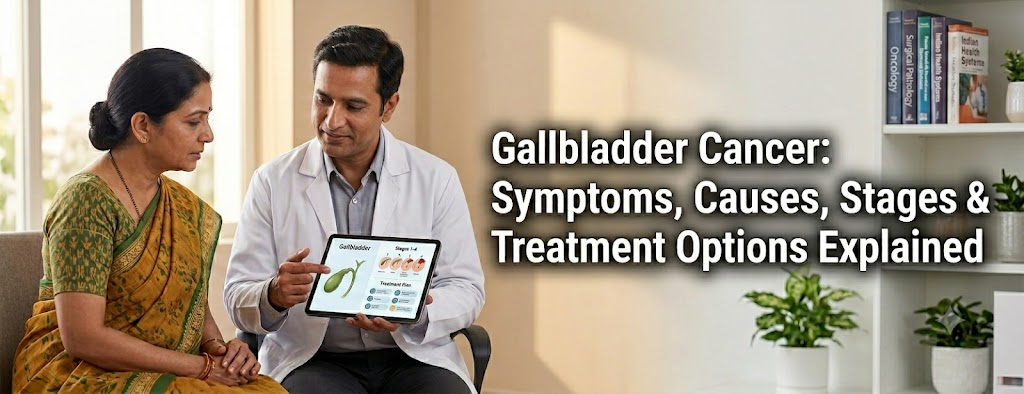
Gallbladder cancer is one of the most common digestive tract cancers in India and one of the hardest to detect early. It rarely causes noticeable symptoms in its initial stages, which is why most cases are diagnosed only after the cancer has already spread. Understanding the risk factors, gallbladder cancer symptoms, and when to seek evaluation can make a significant difference in outcomes.

What Is the Gallbladder and What Does It Do?
The gallbladder is a small, pear-shaped organ located just below the liver in the upper right abdomen. It stores and concentrates bile, a digestive fluid that helps break down fats. When food enters the small intestine, the gallbladder releases bile through the common bile duct to support digestion.
While the gallbladder is not essential for survival, it lies deep inside the body, close to the liver and bile ducts, which means tumours growing within it are difficult to detect on physical examination and often go unnoticed until they are advanced. Gallbladder cancer occurs when cells in the gallbladder wall multiply abnormally, forming a malignant tumour. The most common type is adenocarcinoma, arising from the gallbladder’s inner lining.
Why Is Gallbladder Cancer So Common in India?
India has very high rates of gallbladder cancer, especially in the northern and north-eastern states. States such as Uttar Pradesh, Bihar, West Bengal, and parts of Assam have reported a significant number of cases of Gallbladder Cancer. Several contributing factors have been identified:
- High prevalence of gallstones: Gallstone disease is extremely common in India, particularly among women, and is the strongest known risk factor for gallbladder cancer reason
- Dietary patterns: Diets high in refined carbohydrates and saturated fats and low in fibre promote gallstone risk
- Water contamination: Arsenic and heavy metal contamination in groundwater in certain regions has been linked to a higher incidence
- Delayed medical care: Many patients present late due to limited diagnostic access or attributing symptoms to common digestive complaints
- Chronic typhoid carrier status: Associated with elevated biliary tract malignancy risk in some studies
Awareness of the causes of gallbladder cancer is the first step toward earlier detection.
Gallbladder Cancer Symptoms: Early vs Late Stage
One of the most significant challenges with gallbladder cancer is the absence of specific, recognisable symptoms in early disease. Gallbladder cancer’s early symptoms are frequently mistaken for common digestive conditions.
Early Warning Signs (Easily Missed)
Gallbladder cancer early symptoms that are commonly overlooked:
- Mild, intermittent pain or discomfort in the upper right abdomen, particularly after meals
- Bloating or persistent fullness, especially after fatty foods
- Nausea without an obvious cause
- Indigestion unresponsive to standard antacid treatment
- Gradual loss of appetite
- Unexplained low-grade fatigue
These symptoms overlap with many benign conditions, which is precisely why gallbladder cancer early symptoms are often dismissed for months before a diagnosis is made.
Symptoms of Advanced Gallbladder Cancer
As gallbladder cancer progresses, symptoms become more pronounced:
- Jaundice, yellowing of skin and eyes, caused by bile duct obstruction; the most significant red flag symptom
- Persistent, worsening pain in the upper right abdomen, possibly radiating to the back
- A palpable lump or mass in the upper abdomen
- Dark urine and pale, clay-coloured stools from bile duct obstruction
- Significant unexplained weight loss
- High-grade fever with chills, suggesting biliary infection
- Generalised itching (pruritus) from bile salts accumulating under the skin
Jaundice, alongside any of the above symptoms, requires prompt medical evaluation. Avoid home monitoring.
Causes & Risk Factors for Gallbladder Cancer
The precise gallbladder cancer causes are not fully established, but consistently identified risk factors include:
- Gallstones: The single most significant risk factor. Chronic inflammation from gallstones damages the gallbladder’s inner lining over time. Gallstones larger than 3 cm carry the highest risk.
- Porcelain gallbladder: Calcium deposits in the gallbladder wall, with certain calcification patterns associated with an increased risk of cancer.
- Gallbladder polyps: Polyps larger than 1 cm or those that grow over time require close monitoring or surgical removal
- Chronic cholecystitis: Recurring inflammation of the gallbladder, with or without gallstones
- Anomalous pancreaticobiliary junction (APBJ): A congenital abnormality allowing pancreatic enzymes to chronically irritate the bile ducts and gallbladder
- Gender: Women are affected two to three times more often than men
- Age: Risk increases significantly after 65
- Obesity: Associated with gallstone formation and independent inflammatory risk
- Family history: A first-degree relative with biliary tract cancer modestly elevates risk
Diagnosis: How Gallbladder Cancer Is Detected
Gallbladder cancer is sometimes discovered incidentally. During an abdominal ultrasound performed for an unrelated reason, or during surgery for suspected benign gallbladder disease. When it is suspected based on symptoms or incidental findings, investigations include:
- Abdominal ultrasound: First-line investigation; detects masses, wall thickening, polyps, and gallstones
- CT scan: Detailed imaging of gallbladder, liver, bile ducts, and lymph nodes which are essential for staging
- MRI and MRCP: Excellent visualisation of bile ducts and vascular structures; helps assess operability
- PET-CT scan: Identifies distant metastases and lymph node involvement
- Blood tests: Liver function tests and tumour markers (CA 19-9, CEA), supportive rather than diagnostic
- Biopsy: Tissue confirmation of malignancy; in some cases, surgery is both diagnostic and therapeutic
Gallbladder Cancer Staging
Gallbladder cancer staging follows the TNM system and determines treatment approach and prognosis:
- Stage 0: Cancer confined to the innermost gallbladder layer only
- Stage 1: Cancer has grown into the muscle layer but not beyond; surgery is typically curative
- Stage 2: Cancer has grown through the muscle layer into connective tissue or adjacent liver; surgery may still be possible
- Stage 3: Cancer has spread to nearby lymph nodes or major blood vessels; complex surgery may be required
- Stage 4: Cancer has spread to distant organs; treatment is palliative
The majority of patients in India present at Stage 3 OR 4, reinforcing the importance of investigating persistent gallbladder cancer symptoms early.
Gallbladder Cancer Treatment Options
Gallbladder cancer treatment depends on disease stage, the patient’s overall health, and whether the tumour is surgically resectable. A multidisciplinary team of surgical oncologists, medical oncologists, radiation oncologists, and radiologists guides treatment planning.
Surgery is the primary curative option:
- Simple cholecystectomy for Stage 0 or incidentally detected Stage 1 cancers
- Extended or radical cholecystectomy, removal of the gallbladder with a margin of liver tissue and regional lymph nodes; standard for Stage 1 and 2
- Hepatic resection with bile duct reconstruction for tumours involving adjacent structures, requiring specialist HPB surgery expertise
Chemotherapy is used adjuvantly after surgery to reduce recurrence risk, and palliatively for advanced inoperable disease. Gemcitabine with cisplatin or capecitabine are standard regimen.
Radiation therapy, delivered by our department of radiation oncology, is used as adjuvant therapy post-surgery or palliatively in advanced disease. Advanced techniques, including IMRT and SBRT, ensure precision while protecting surrounding healthy tissue.
Targeted therapy and immunotherapy are available for selected patients based on molecular tumour profiling, including actionable mutations such as FGFR2, IDH1, and HER2, as well as MSI-high status.
Palliative care, including biliary stenting, pain management, and nutritional support, is an essential component of care for patients with advanced, unresectable disease.
Can Gallbladder Cancer Be Prevented?
While complete prevention is not guaranteed, these steps meaningfully reduce risk:
- Address gallstone disease promptly, and discuss cholecystectomy with your doctor if gallstones are symptomatic or large
- Monitor gallbladder polyps on the schedule your doctor recommends
- Maintain a healthy body weight
- Follow a balanced diet rich in fibre and low in refined carbohydrates
- Attend routine health check-ups that include an abdominal ultrasound
- Do not ignore persistent digestive symptoms for more than two to three weeks
When to See a Doctor ?
Seek prompt evaluation if you experience jaundice, persistent upper right abdominal pain, unexplained weight loss, a palpable abdominal lump, or new symptoms in the setting of known gallstones or polyps.
At Kokilaben Dhirubhai Ambani Hospital, our HPB surgery and oncology teams offer comprehensive gallbladder cancer treatment from diagnosis through surgery, bile duct cancer treatment, chemotherapy, and radiation. Early specialist referral significantly expands treatment options.
Conclusion
Gallbladder cancer is serious but more manageable when caught early. Vigilance about gallbladder cancer symptoms, timely investigation of risk factors, and prompt specialist referral are the most important steps any patient or family member can take.
Book a consultation at Kokilaben Dhirubhai Ambani Hospital today. Our specialist team is ready to evaluate, diagnose, and guide you through the most appropriate care pathway.
Frequently Asked Questions
Q1: Can you survive gallbladder cancer?
Yes, if it is detected early. Stage 1 and 2 cancers treated surgically have meaningful survival rates. Advanced-stage disease carries a poorer prognosis, but early diagnosis remains the most critical factor.
Q2: Is gallbladder cancer hereditary?
Gallbladder cancer is not primarily hereditary. Most cases are linked to environmental and lifestyle factors, particularly long-standing gallstone disease.
Q3: What is the difference between gallbladder cancer and bile duct cancer?
Both are biliary tract cancers, but originate in different locations. Gallbladder cancer begins in the gallbladder wall; bile duct cancer (cholangiocarcinoma) arises in the bile ducts. They share some risk factors but require different management.
Q4: Does removing the gallbladder reduce cancer risk?
Yes. Cholecystectomy eliminates the risk of gallbladder cancer developing within the organ, which is why timely surgery is recommended for symptomatic gallstone disease or high-risk polyps.
Q5: What is the recovery like after gallbladder cancer surgery?
A simple cholecystectomy allows rapid recovery. Extended surgery involving liver resection or bile duct reconstruction requires longer hospitalisation and a more gradual return to activity. Your surgical team will provide a personalised recovery plan.