
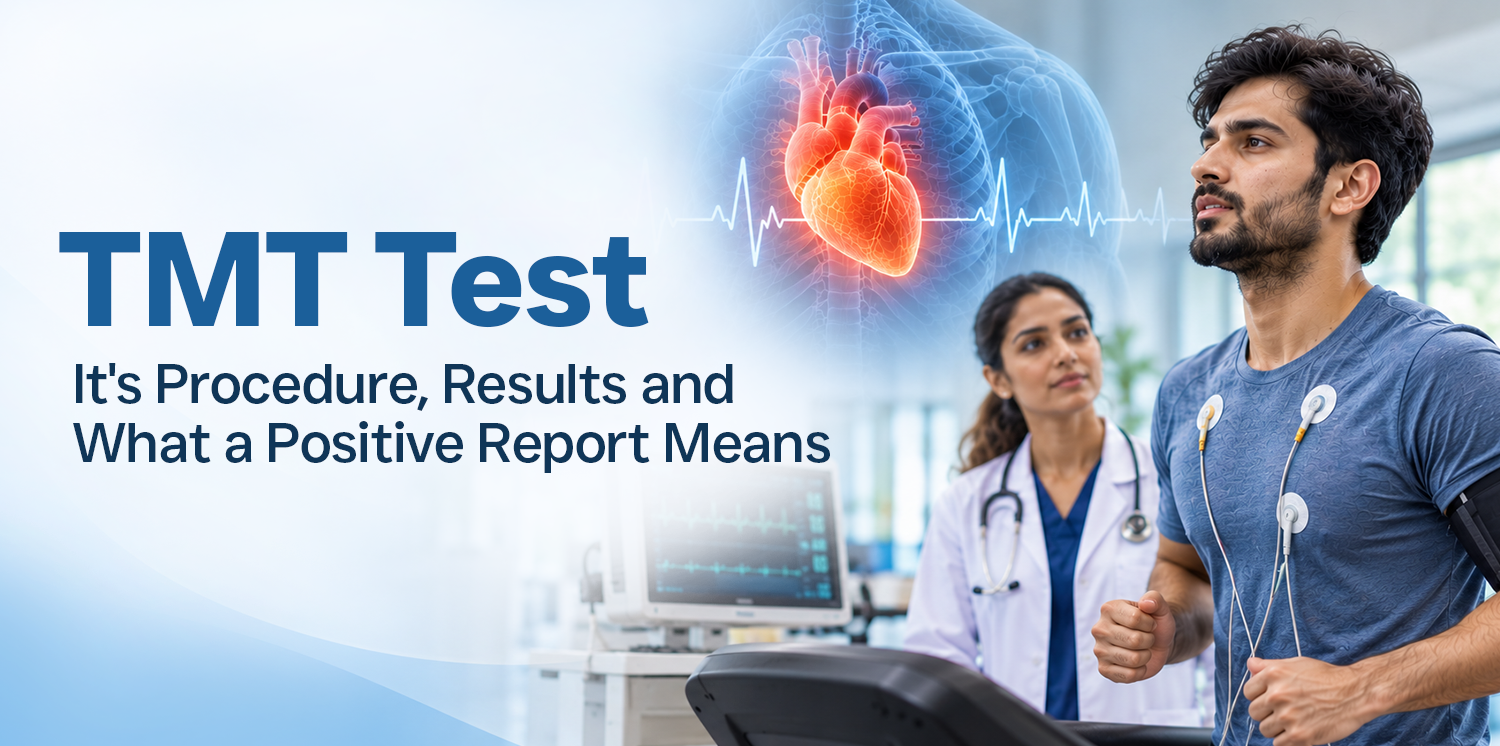
A TMT (treadmill) test looks at how your heart functions during exercise. You walk on a treadmill while the medical team monitors your ECG, heart rate and blood pressure. The results help identify signs of reduced blood flow to the heart.

If you’ve searched for “what is a TMT test” or wondered what it means after your doctor ordered one, this guide explains everything in simple language. Many people feel apprehensive about a TMT stress test because they don’t know what to expect. This article covers why the test is performed, how the procedure works, what the results mean and what happens after a positive report.
What Does a TMT Test Mean?
TMT stands for Treadmill Test. It is also known as an exercise stress test, exercise ECG or treadmill stress test. All these terms refer to the same test.
When a person exercises, the heart pumps more blood, and its muscles require more oxygen. If an artery is narrowed and cannot deliver enough blood, the heart may experience strain. This problem may remain hidden when the body is at rest.
An ECG may appear normal when a person is lying down but show changes during physical activity. A TMT test helps identify these changes by putting the heart under controlled physical stress.
During the test, the ECG monitors the electrical activity of the heart. The medical team also records the heart rate, blood pressure, symptoms and the duration of exercise.
TMT Test for the Heart (Treadmill Test): Why Is It Done?
The primary purpose of a treadmill test is to assess how the heart performs under physical stress and evaluate the possibility of coronary artery disease.
A doctor may recommend a TMT test in the following situations:
- Chest pain, pressure or tightness while walking, climbing stairs or rushing.
- Unexplained breathlessness during physical activity.
- Risk factors such as high blood pressure, diabetes, smoking, high cholesterol or a family history of heart disease.
- An abnormal ECG at rest.
- Before surgery, when the doctor wants to understand how the heart handles physical stress.
- Before starting an exercise programme, especially for people above 40 or those with existing risk factors.
- Follow-up after bypass surgery or angioplasty to assess how the heart responds to physical activity.
A TMT test helps doctors assess the possibility of blocked arteries, but it does not show the arteries themselves. It indicates whether the heart shows signs of ischaemia (reduced blood flow). It cannot identify the exact location or severity of a blockage. Tests such as CT coronary angiography and coronary angiography provide direct images of the arteries.
If breathlessness is the primary complaint, the doctor may also examine the lungs because lung conditions can cause similar symptoms. A pulmonary function test in Mumbai measures how well the lungs are working and helps distinguish between cardiac and pulmonary causes.
Who Should and Shouldn’t Have a TMT Test?
A cardiologist will decide whether a TMT test is appropriate for an individual. The following table provides a general guide.
| Who May Need a TMT Test | Who Should Not Have a TMT Test |
|---|---|
| Adults with chest pain or breathlessness during physical activity | People who have had a heart attack in the last few days |
| People with high blood pressure, diabetes, high cholesterol, a smoking habit or a family history of heart disease | People with unstable chest pain, including pain at rest or worsening pain |
| People with an abnormal resting ECG | People with serious heart rhythm problems that medicines do not control |
| People planning to start regular exercise or heavy training | People with severe heart failure or severe symptomatic narrowing of the aortic valve |
| People who have undergone bypass surgery or angioplasty | People with very high blood pressure that medicines do not control |
| People who need a heart check before surgery | People with fever, an active infection or a blood clot in the lungs |
Some people cannot walk on a treadmill because of arthritis, leg pain, balance problems or breathing difficulties. In such cases, their doctor may recommend a stress echo, which uses ultrasound images of the heart during stress, or a nuclear stress test. Sometimes, medication is used to increase the heart rate instead of physical exercise.
A consultation at a cardiology hospital in Mumbai can help a cardiologist determine whether a TMT test is suitable and safe.
How Is a TMT Test Done? Step-by-Step Procedure
How to Prepare for a TMT Test
Before undergoing a TMT test, patients should follow these general preparation guidelines:
- Wear loose clothing and comfortable walking or sports shoes.
- Eat a light meal 2–3 hours before the test and avoid heavy meals.
- Avoid tea, coffee and smoking for a few hours before the test.
- Continue regular medication unless the doctor gives different instructions. Never stop heart medication without medical advice.
- Inform the doctor about all medications. People with diabetes should carry a snack and inform the medical team.
- Bring previous ECG reports and other relevant medical records.
What Happens During the TMT Test?
The procedure generally involves the following steps:
- Check-in and resting measurements: The medical team takes the patient’s medical history and asks about symptoms. A resting ECG and blood pressure reading are recorded.
- Electrode placement: Small patches are placed on the chest after cleaning the skin. Sometimes, a small area of hair may need to be shaved. ECG electrodes are attached, and a blood pressure cuff is placed around the arm.
- Walking on the treadmill: The treadmill starts at a slow speed. Every three minutes, its speed and incline increase, making the walk progressively more challenging.
- Reaching the target heart rate: The patient continues exercising until the target heart rate is reached, approximately 85% of 220 minus the person’s age. The medical team may stop the test if the patient experiences chest pain, dizziness, severe fatigue, breathlessness or concerning ECG changes. Patients should immediately report any discomfort.
- Recovery: After the exercise, the patient sits or lies down while the medical team continues monitoring the ECG and blood pressure for approximately 5–10 minutes.
The entire visit generally takes 30–60 minutes, while the actual treadmill exercise lasts approximately 6–15 minutes.
The test should be performed at a heart hospital in Mumbai, where trained medical staff and emergency equipment are available.
The cardiologist reviews the ECG recordings and provides the report, usually on the same day or the following day.
TMT Test Positive Means: What Happens Next?
A positive TMT test means that the ECG findings and/or symptoms during exercise suggest reduced blood flow to the heart. The doctor evaluates specific ECG changes, chest pain, a fall in blood pressure or an abnormal heart rhythm.
However, a positive result does not automatically mean that a person has heart disease. False-positive results can occur, particularly in women, people with an already abnormal resting ECG and those taking certain heart medications.
A positive TMT result is generally a reason for further evaluation rather than a final diagnosis.
The cardiologist may recommend one of the following next steps:
- Stress Echo: An ultrasound examination performed during physical or medication-induced stress to assess how well the heart muscle contracts.
- CT Coronary Angiography: A scan using contrast dye to examine the coronary arteries and identify possible narrowing.
- Coronary Angiography: A procedure that directly examines the coronary arteries to identify blockages. If necessary, treatment may also be performed during the same session.
- Medicines and Lifestyle Changes: The doctor may recommend medication and lifestyle modifications to help protect heart health.
If the test identifies an irregular heartbeat, the doctor may also refer the patient to an electrophysiologist in Mumbai, a specialist who treats heart rhythm disorders.
What Does a Negative TMT Test Mean?
A negative TMT result means that the ECG remained normal during the test and the patient reached the target heart rate without developing concerning symptoms.
This is generally reassuring, but it does not guarantee that the coronary arteries are completely healthy. Mild or early blockages may not reduce blood flow enough to cause detectable changes during exercise. Therefore, a negative TMT test cannot rule out every heart condition.
Patients should continue following their doctor’s advice and seek medical attention if they develop new chest pain or breathlessness.
What Does an Inconclusive TMT Test Mean?
An inconclusive TMT result means that the doctor cannot determine whether the test is positive or negative.
This may happen when a patient cannot reach the target heart rate because of fatigue, leg pain, breathlessness or medication that slows the heart rate. It may also occur when the resting ECG is already abnormal or the recorded ECG signals are unclear.
In such situations, the doctor may recommend another investigation, such as a stress echo, to obtain more information about heart function.
Is a TMT Test Safe? Understanding the Risks
A TMT test is generally safe for most people when performed under the supervision of trained medical professionals.
Most people experience only temporary tiredness, sweating or mild muscle soreness after the test. Some may also develop skin irritation from the ECG electrode patches.
Less commonly, people may experience chest pain, dizziness or palpitations. If these symptoms occur, the medical team stops the test immediately.
Serious complications, such as dangerous heart rhythm disturbances, fainting or a heart attack, are extremely rare. Emergency equipment and trained staff are available during the procedure.
Patients should inform the medical team about chest pain at rest, recent illnesses or any new symptoms before starting the test. They can also ask to stop the test if they feel uncomfortable.
Conclusion
A TMT (Treadmill Test) provides doctors with a quick and useful indication of how the heart functions under physical stress. It helps assess the possibility of coronary artery disease, although it does not directly show the coronary arteries.
A positive TMT result means further evaluation may be necessary, not that a person definitely has heart disease. A negative result is reassuring but does not guarantee that there are no heart problems.
Proper preparation, sharing symptoms with the medical team and discussing the report with a cardiologist are important parts of the process.
The cardiology team at Kokilaben Dhirubhai Ambani Hospital can guide patients through the TMT procedure, explain the results and recommend appropriate next steps.
Frequently Asked Questions (FAQs)
1. What is the full form of TMT in medical terms?
TMT stands for Treadmill Test. It is also known as an exercise stress test or exercise ECG.
2. What does a TMT test show?
A TMT test shows how the heart responds to physical exercise. It records the ECG, heart rate and blood pressure while monitoring symptoms such as chest pain. The results help doctors identify possible signs of reduced blood flow to the heart. However, the test does not directly show the coronary arteries.
3. Is a positive TMT test serious?
Not necessarily. A positive TMT result may indicate reduced blood flow to the heart, but it does not confirm heart disease. False-positive results can also occur. The cardiologist may recommend further investigations, such as a stress echo or CT coronary angiography.
4. How long does a TMT test take?
The complete procedure generally takes 30–60 minutes. Patients usually walk on the treadmill for approximately 6–15 minutes, while the remaining time is used for preparation and recovery.
5. Do I need to fast for a TMT test?
Fasting is generally not required. Patients are usually advised to have a light meal 2–3 hours before the test and avoid heavy meals, tea, coffee and smoking. They should also consult their doctor about their regular medications, especially if they have diabetes or heart-related conditions.
6. What’s the difference between a TMT and a 2D Echo?
A TMT is a treadmill stress test that records the ECG and blood pressure while a person exercises. A 2D Echo uses ultrasound to examine the size of the heart, its valves and its pumping function at rest.
Neither test directly shows the coronary arteries. A stress echo combines ultrasound imaging with physical or medication-induced stress to assess how the heart functions under increased workload.